Saturday, 19 October 2013

Himeji and the Bizen Kilns


We took a one week trip around central Japan to many areas I hadn't seen before. We visited Himeji in Okakyama prefecture which is Adelaide's sister city. It is a good choice as it is a pretty place surrounded by hills and with a magnefiicient castle and gardens.This is the best preserved and most beautiful castle in Japan.


South of there is the town of Bizen, on the Inland, or Seto, Sea. Bizen is world famous for its pottery that has a unique, rough, earthy, burnt look.
There are dozens and dozens of kilns, raging from large operations to very small artisanal family firms.

Once again to my untrained eye it was all marvellous but I found it impossible to tell the great difference between the first tea bowl illustrated here, worth about $140 and the second one worth $13,000.


Its all great stuff though and easy to see why the natural looking nature of this style became so popular. As the surfaces can be fairly rough I sometimes find the cups and bowls uncomfortable to drink from though, they prickle.


Wood neatly stacked ready for the kilns.

You see these piles of wood everywhere and the regularly sized bundles must be useful for calculating how much wood to add to the fire at any point.


This is the most ancient style of pottery in Japan. The firing takes many days and the final pieces display scortch marks and markings from the wood and ash.


Monday, 14 October 2013

Sumo do


On my birthday we went to see the Sumo wrestling for the first time. There is a season in Tokyo, Kyushu and Nagoya and somehow we always have seemed to miss it in the past.

What a wonderful way the spend the day it is.

The matches start at 8.30 in the morning and go on until six. The most important bouts coming last.

The whole thing is  fascinating, mysterious and hugely entertaining.  People wander in and out, come for the day, the morning or just the most important bits.


The whole area of Tokyo around the Sumo stadium is devoted to the sport and entertaining the players and spectators. When you arrrive at the station there are massive posters of the most famous wrestlers and their hand prints, weight and height. They're big boys, 175 kilos is not unsual.

The wrestling itself is very ancient and was once a religious ceremony. this explains the enormous amount of ritual involved. The ring, a raised platform of clay,  is itself sacred and cannot be approached, let alone touched by ordinary people. Just when you think you are starting to understand things, out comes someone in spectacular robes and does something inpenetrable in its mystery.

 There are famous Sumo "schools' or "houses' and a wrestler joins at an early age pretty well for life. During the season everyone gets to wrestle everyone else several times and the winner is of course the one who wins the most bouts.

You win by pushing the other guy out or by making any part of his body, apart from the soles of his feet, touch the ground. I used to think it was just a bunch of big blokes pushing each other around. But not at all... they are amazingly strong and very, very sneeky. We saw one chap pick up a larger fellow and basically turn him upsidedown. That's 150 kilos you have to rotate at about arm's length.


The players are ranked into various complex grades, the very top of the top has only been awarded a few dozen times in history. This person thus anointed cannot be downgraded but is expected to retire gracefully as the wheels start falling off.


We were lucky enough to see Endo, bloke on the left, wrestling. He is the rising star and only 22 years old. We saw him demolish someone who had been a Sumo wrestler since Endo was two years old.  You could feel the tension building as he appeared and the crowd went wild when he won.


In the traditonal seats on the ground floor you actually sit in a very small matted area. about 1.5 square meters for a party of four.


There a dozens of special bento luncheon restaurants at the place that deliver: bento boxes, beer, sake, etc to your seat.


 The four old girls in front of us brought their own picnic that consisted of a small amount of rice cakes and several very large bottle of scotch which they attacked with gusto. They had even brought their own ice, soda and shwizel sticks.

They were having a ball.... as were we.


Thursday, 20 June 2013

Soba.. more than just a noodle


Soba, buckwheat noodles, are enormously popular in Japan. In fact they are probably one of the top three eaten foods in restaurants along with sushi/sashimi and curry rice.

The soba plant isn't a wheat variety it is quite a different thing. It grows well in cold areas and those with poor soils so you will often find it in the mountains and northern areas. Very popular in Russia it is the basis for blinis, Russian pancakes. Also in Brittany it is called "black wheat" or  "Sarrasin" and used to make pancakes. "Sarrasin" because buckwheat came to France through Spain during the Moorish imvasions.

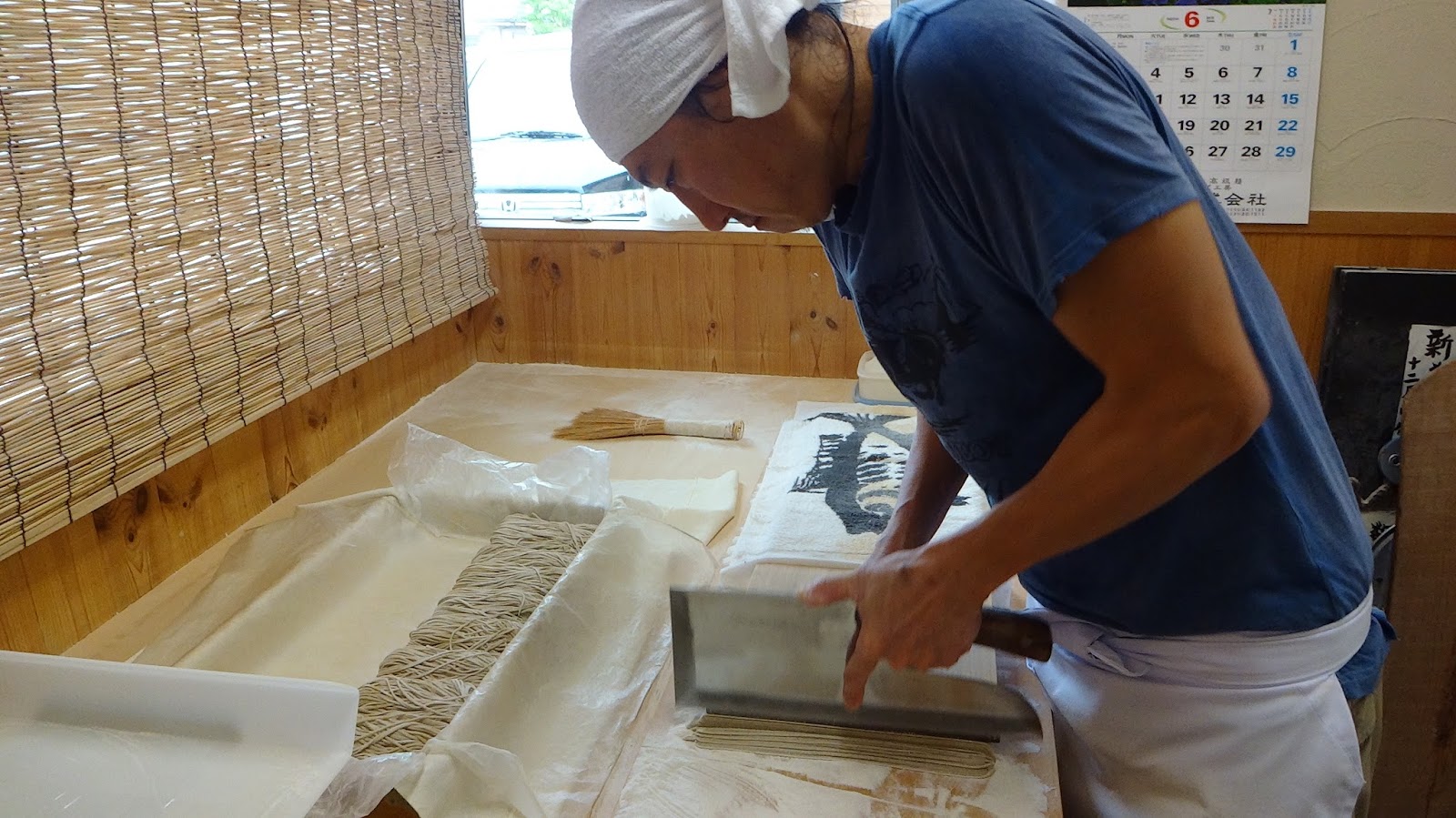
Making noodles out of soba flour is no simple matter. The great soba restaurants make their own noodles fresh each day. It is a very exacting process that takes years to learn.

Near our house there is one of the best three soba restaurants we have ever eaten in. Katsura Taguma is a master soba maker and his little restaurant is a joy. Beautiful inside, fine pottery ware and of course excellent soba.


He and his wife have become friends of ours and this morning I was invited bright and early to watch him make the day's noodles.


Katsura spent eight years perfecting his craft and apart for one day a week's rest, makes one to two batches of noodles each day. This as well as doing the preparation for the restaurant and all the cooking. It is a labour of love and requires extraordinary skill and dedication.

80% soba flour is mixed with 20% wheat flour. This is necessary to make the noodles bind together well. Occasionally a noodle master will offer you 100% soba flour noodles, but these are very difficult to make and are really only for special occasions.

For about 20 minutes the mixure is kneaded with fresh water in a special large lacquer bowl. the wooden lacquer bowl is imprtant as it is insulating and helps keep the temperature constant.


The dough is then carefully rolled out and refolded using a series of long wooden rollers.


 The large square, flat sheet is then folded many times on itself.


A layer of soba flour in sprinkled onto a board and then the cutting process begins.
The noodles are evenly and very carefully cut to 2mm width and wind up being incredibly even.

This batch made about sixty servings. If he sells out at lunch he then makes another batch for the dinner service. Each batch takes about 1 1/2 hours from start to finish.


Friday, 7 June 2013

Gai Rai Go Japanese words from foreign languages.

外来語

Gai Rai Go is both a joy and a trial for foreigners in Japan. In a sea of Kanji and squiggles you sometimes come across a word that has obviously come from another language, increasing your chances of understanding it, ...or so you think.

They are almost always written in Katakana, the more angular of the two scripts, so this is a signal that that you are about to launch into a hybrid world.

The most common borrowings are from English, followed by French, German, Portuguese and Italian. The problems though are many:

Firstly you have to say the word aloud often with a Japanese accent to try and work out what it originally was. Secondly Japanese poetic license has often led the word far from its original meaning. Basically every time you are tackling a one-word cryptic crossword.

Say hello to furosuti.

The results of this all this are often quite hilarious:

Some of my favourites are listed here, see if you can work them out: The answers are below:

1)   Patoka

2)    Manshyun

3)    Renji

4)   Wapro

5)   Serufu

6)   Consento

7)   Rasutosheen

8)   Pan

9)   Konbeeni

10) Bikingu

11)  Arubaito

12)  Anketo

13)  Heapinkabu

14)  Semi


 Kohi and sandoichi available at this place.


 Takushi!


The ubiquitous Makudonarudo Hanbaagaa.


 Answers:

1)   Patoka:          A police car. ...Patrol Car


2)   Manshyun:   Not a huge house with indoor pool, but the Japanese word for an  
                           apartment.


3)    Renji:           A microwave oven......Range


4)   Wapro:         Word Processor


5)   Serufu:           Self Service


6)   Consento:     An electric wall plug/socket.... from "consent" if you can believe it.


7)   Rasutosheen:  You're just starting to enjoy a film then unfortunately it the
                              Rasutosheen.


8)   Pan:               Bread, from the French "pain".


9)   Konbeeni:      A convenience store.


10) Bikingu:          A smorgasbord, from "Viking".

11).  Arubaito:     Part time work, from the German "Arbeit", work.

12)  Anketo:       A questionnaire from the French "Enquete", which has the same
                           meaning.


13) Heapinkabu:  A hairpin curve/bend.

14) Semi:          A tutorial, from "seminar".


But it is not a one way street. in English we have from the Japanese:

Rickshaw:   Jinrikusha, person effort car.

and

Tycoon:       Daikun.  Big man/noble.


Sunday, 2 June 2013

Kyushu 2 Sake and food

Like all Japanese the residents of Kyushu are justly proud of their regional food and drink. Everywhere you go someone will claim that their area has the best sake. In the case of Kyushu it is probably true.


We went to see a very old brewery where the family have been making sake in the same building for four hundred years.


Upstairs was an attic full of  ancient wooden brewing equipment each one a work of art.

 Making sake is more like winemaking than beer brewing.

There is only one harvest a year and fresh rice is used so it is not a year round process like beer. Also like wine, there are special varieties of rice that are only used for sake making and are not eaten.
Use of different yeasts, temperatures and aging techniques gives rise to a huge number of different styles and tastes.

Like beer however the quality of the water is of utmost importance. So ususally the best sakes are from the areas with the highest quality water.


One of the other great joys of the place was the quality of the inns and the food . We stayed in two separate onsens one large one small, both with rockpools of hot bubbling clean water. In the smaller one we had our own outdoor bath attached to the room in a little garden, a lovely way to start the day.


The assortment or starter  dishes for dinner.

The great thing about onsens is not just the hot water but the food. Included in the room price is dinner, usually with about 15 different dishes and breakfast with about 8 different tasty things.


Breakfast


One of the specialties of the region is  mentaiko, chili pickled cod roe. It's great on rice and makes excellent spaghetti as well.


Another local speciality is tonkotsu ramen. Soup noodles made with pork bone soup and thin noodles. It has a milky colour and a very gentle taste, not at all porky or fatty. The thin noodles are my favourite sort as they don't feel as heavy when you eat them and you don't get the feeling of chewing your way through a whole bag of wheat.


Squid in many shapes and sizes in a major Kyushu  obsession.  Stuffed, grilled, dried, raw, big and small it really ought to appear on the prefectural flag.